
Design Guides
Kitchen Trash Can Size Guide: What Size Do You Actually Need? (2026)
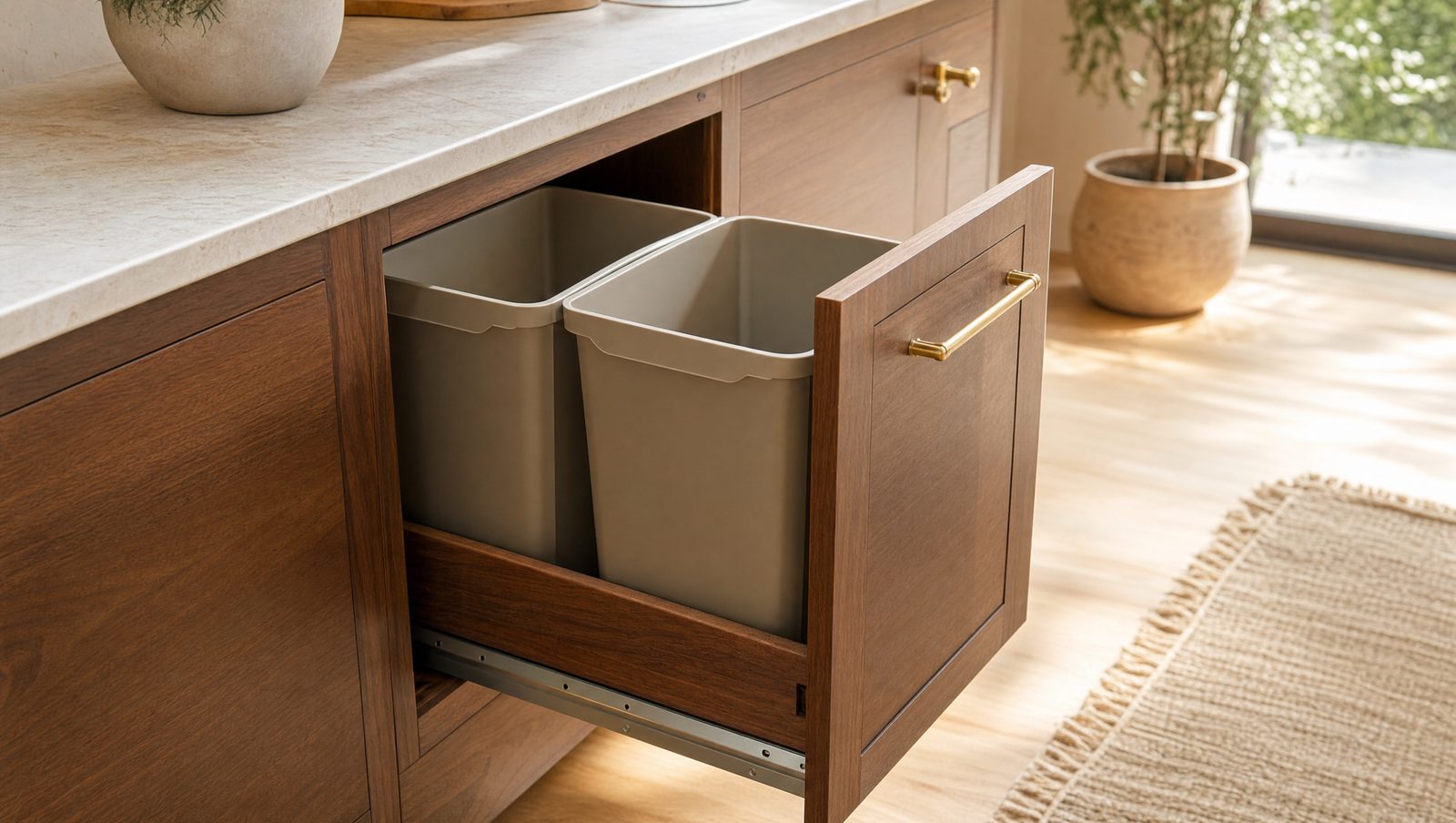
Nobody plans a kitchen around the trash can. Then it doesn't fit the pull-out, or it's full by Tuesday, and suddenly it's the most annoying thing in the room. Most kitchen cans hold 12 to 16 gallons, with 13 gallons the default — but the right size depends on your household and, more than anything, your cabinet. Here's how we size it.
What is the standard kitchen trash can size?
The standard kitchen trash can holds 12 to 16 gallons and measures roughly 24 to 28 inches tall with a 14 to 16-inch diameter (Fabuwood, 2026). Thirteen gallons is the default for a reason: it matches the most common tall kitchen bag size, so liners are easy to find anywhere.
If you're buying a freestanding can, 13 gallons is the safe answer. If it's going inside cabinetry, the cabinet decides — not the can.
| Household | Recommended capacity |
|---|---|
| 1–2 people | 7–10 gallons |
| Family of 4–6 | 12–16 gallons |
| Want fewer trips out | Up to 20 gallons |
| Freestanding standard | 13 gallons |
Source: Fabuwood & Plasticplace, 2026.
What size trash can does your household need?
Match capacity to how much you actually generate. A one- or two-person household does fine with 7 to 10 gallons, while a family of four to six wants 12 to 16 gallons (Plasticplace, 2026). If you hate taking the trash out, sizing up to 20 gallons buys you days between trips.
There's a catch, though. A bigger can means trash sits longer, and longer means odor. Bigger isn't automatically better — it's a trade between trips and freshness.
Do you cook from scratch most nights? Then size up. Order in and recycle heavily? A smaller bin plus a dedicated recycling bin usually beats one oversized can.
What size trash can fits in a pull-out cabinet?
Pull-out bins are built around standard cabinet widths of 12, 15, or 18 inches, and they rarely exceed 20 inches in height so they clear the countertop — which caps capacity at about 20 gallons (Dimensions Chart, 2026). A typical cabinet bin runs around 15 inches wide and 20 inches tall.
Width is what decides your layout. A 15-inch cabinet usually takes a single bin; an 18-inch or wider cabinet can carry two bins side by side — one trash, one recycling. That's the detail worth planning early.
Remember the can must be smaller than the opening. The pull-out hardware, the frame, and the door all eat into the space before the bin does. You can see the systems we use on our cabinet accessories page.
What about a trash can under the sink?
Under the sink is the tightest spot in the kitchen. The basin and the plumbing steal most of the height, leaving roughly 16 to 20 inches for a bin (PD Measurement, 2026). Your can has to fit around the pipes, not just inside the cabinet.
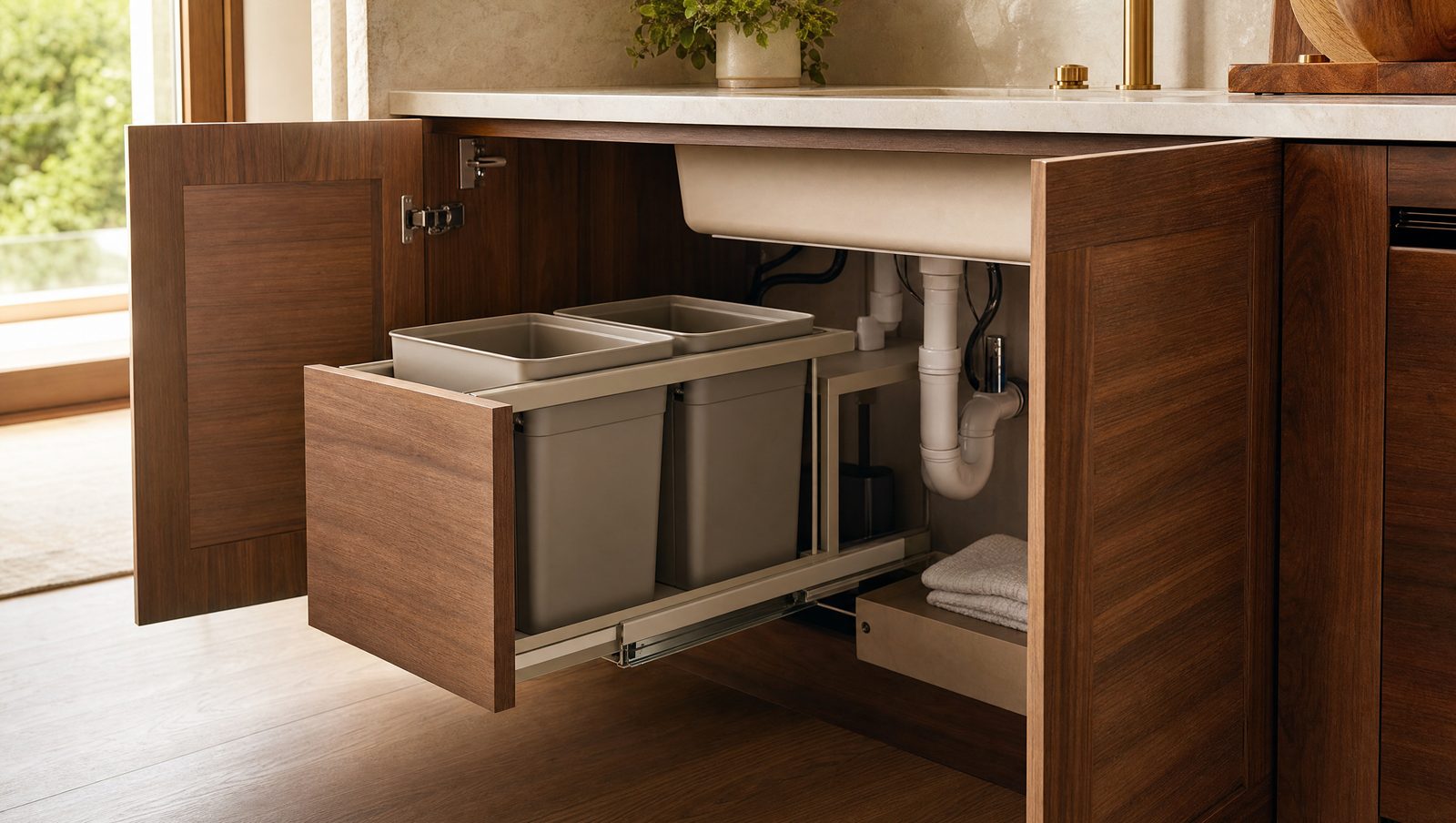
It works, but it's a compromise. If you have a choice, a dedicated pull-out cabinet elsewhere in the run is almost always the better home for the trash.
Should you build the bin into your cabinetry?
If you're building custom, yes — plan the bin before the layout is final. A built-in pull-out keeps the can off the floor, out of sight, and out of the walkway, and it lets you pair trash with recycling in one motion.
Our finding: the trash pull-out is the single most-used accessory in nearly every kitchen we build, and it's the one clients most often forget to plan. When it gets retrofitted afterward, the compromise is always the same — an awkward width, a bin that's too small, or a can parked in the open. Decide it early and it disappears into the cabinetry.
Placement matters as much as size. The bin belongs near the prep zone and the sink, not across the room. We spec pull-out bins and soft-close hardware as part of the cabinetry, so the width, the door, and the bin are designed together instead of negotiated later.
How do you choose the right size?
Work backwards. Start with where the bin will live, measure the cabinet width you can give it, then pick the largest bin that fits comfortably — not the largest bin that exists. Cabinet width sets the ceiling; household size tells you where to land under it.
Then decide on recycling. If you want both in one cabinet, you need the wider opening from the start. That single choice, made early, is the difference between a kitchen that handles waste invisibly and one where the trash can is the first thing you see.
Frequently asked questions
What is the most common kitchen trash can size?
Thirteen gallons is the most common, within a standard range of 12 to 16 gallons (Fabuwood, 2026). It matches the most widely sold tall kitchen bag size, so liners are easy to find.
What size trash can fits in a 15-inch cabinet?
A 15-inch cabinet typically takes a single pull-out bin around 15 inches wide and up to 20 inches tall (Dimensions Chart, 2026). The hardware and door frame reduce the usable width, so the bin is always smaller than the cabinet.
Can you fit two bins in one cabinet?
Yes, in an 18-inch or wider pull-out. Standard pull-out cabinets run 12 to 24 inches wide and may hold one or two bins (Dimensions Chart, 2026), which lets you pair trash and recycling in one pull.
How tall can an under-sink trash can be?
Roughly 16 to 20 inches, because the sink basin and plumbing take up the rest of the cabinet (PD Measurement, 2026). The can also has to clear the pipes, not just fit the opening.
Is a bigger trash can always better?
No. Larger cans mean fewer trips but trash sits longer, which invites odor. A family of four to six is well served by 12 to 16 gallons (Plasticplace, 2026); size up only if you genuinely want fewer trips.
The bottom line
Thirteen gallons is the default, 12–16 covers most families, and 7–10 suits a smaller household. But if the bin lives in your cabinetry — and it should — the cabinet width sets the real limit, and 20 gallons is about the ceiling for a pull-out. Measure the cabinet first, then choose the can.
Book a design consultation and we'll design the waste pull-out into your kitchen from the start.
Sources
- Fabuwood, Kitchen Trash Can Size Guide, retrieved 2026-07-15, link
- Plasticplace, What Size Trash Can for Kitchen Is Best?, retrieved 2026-07-15, link
- Dimensions Chart, Kitchen Trash Can Dimensions Chart 2026, retrieved 2026-07-15, link
- PD Measurement, Kitchen Trash Can Dimensions: Complete Size Guide 2026, retrieved 2026-07-15, link